
About Etosha National Park
Etosha National Park covers 22,270 km² of northwestern Namibia and is centred on the Etosha Pan — a vast, flat, saline depression covering approximately 4,800 km², approximately 130 km long and 50 km wide. The pan is the remnant of a lake that dried up due to geological and climatic changes; during the rainy season, it receives shallow flooding that attracts hundreds of thousands of flamingos and other waterbirds.
The park was proclaimed a game reserve in 1907 by the German colonial administration, making it one of the oldest protected areas in Africa. It achieved national park status in 1958 and was progressively extended and fenced to its current boundaries. Etosha is one of the best-managed and most accessible national parks in Africa, with an extensive network of tar and gravel roads navigable by standard 2WD vehicles.
Etosha's ecology is driven by the pan. During the dry season (May to October), animals are drawn to waterholes distributed around the pan's edge and throughout the park. The concentration of prey at these fixed water points creates exceptional opportunities for predator sightings. Three of the park's main rest camps — Okaukuejo, Halali and Namutoni — have floodlit waterholes that allow wildlife viewing from sunset until midnight.
The park is home to both black and white rhino. Black rhino are most frequently seen at the Okaukuejo floodlit waterhole after dark — one of the most reliable black rhino sighting locations in the world. The Etosha black rhino population, estimated at approximately 150 individuals (2024), represents a significant proportion of Namibia's total population.
Wildlife
Black Rhino
One of Africa's best locations. Okaukuejo floodlit waterhole is world-renowned for after-dark sightings.
White Rhino
Reintroduced in recent years; sightings increasing. Eastern sections of the park particularly productive.
Lion
Well-distributed throughout. Pride sizes range from small family groups to larger coalitions. Active at night around waterholes.
Leopard
Present but less commonly seen than in South African reserves. Best found on night drives in the western sections.
Cheetah
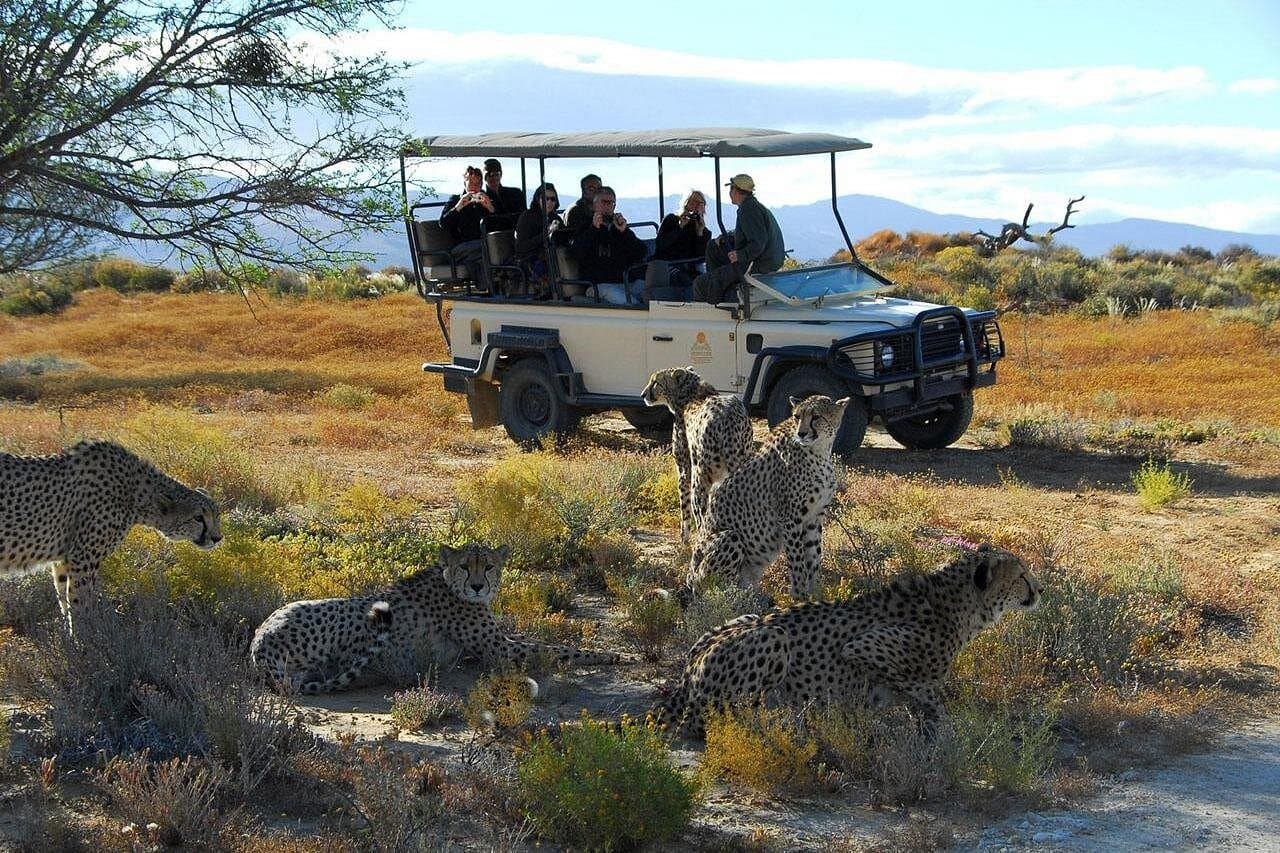
Etosha is one of Namibia's best parks for cheetah sightings, particularly in the open, flat areas of the eastern park.
Elephant
Large herds, particularly in the eastern sections. Namutoni area and Fisher's Pan are excellent.
Giraffe
Namibian giraffe (Giraffa camelopardalis angolensis) are abundant throughout the park — one of Etosha's most commonly sighted large mammals.
Oryx (Gemsbok)
The iconic oryx is one of Etosha's most commonly seen animals, adapted perfectly to the arid environment.
Flamingo (seasonal)
Hundreds of thousands of lesser and greater flamingo visit the pan during and after the rains (December–April).
Camps and Accommodation
Okaukuejo Rest Camp
The most famous camp in Etosha. The floodlit waterhole is considered one of Africa's great wildlife spectacles. Black rhino, elephant and lion are regular nocturnal visitors. Facilities include a restaurant, shop, filling station and swimming pool. Accommodation from basic camping to chalets and luxury cottages.
Halali Rest Camp
Centrally located. Floodlit waterhole. Quieter than Okaukuejo. Good for lion sightings. Bush walk at dusk available (ranger accompanied).
Namutoni Rest Camp
Eastern Etosha; close to Fischer's Pan and the Andersson Gate. 19th-century German fort forms the centrepiece of the camp. Excellent elephant and giraffe sightings nearby.
Onkoshi Camp (Exclusive)
NWR's luxury camp on the eastern shore of the pan. 15 chalets on elevated platforms. Outstanding views across the pan. Open to exclusive booking. From approximately N$5,000 per person per night.
All NWR camps must be booked through Namibia Wildlife Resorts (nwr.com.na). October availability during the tournament period is likely to be limited. Book well in advance.
Best Time to Visit — Tournament Season
October
ExcellentPeak dry season conditions. Vegetation at its most sparse. Waterholes active around the clock. Animals in good condition following the dry season. Temperatures 28–36°C with cool nights. Virtually no rain.
November
Very GoodFirst rains typically begin in November. Waterholes still active and productive. Vegetation begins greening after rains. Migratory birds (including some flamingos) begin arriving. Temperatures 30–38°C with periodic afternoon thunderstorms.
Book Etosha Tours
Guided day tours and multi-day Etosha safaris departing from Windhoek, bookable through Viator.